
Earthing installation is a non-negotiable requirement for every electrical project in Saudi Arabia, from residential towers to industrial substations. A correctly executed earthing installation protects personnel from electric shock, safeguards equipment from fault currents, and ensures compliance with the Saudi Building Code (SBC 401), IEC 60364, and Saudi Electricity Company (SEC) distribution standards. This guide covers every stage of grounding system installation in KSA: design, execution, materials, compliance, and cost.
What Is Earthing Installation?
Earthing installation is the process of connecting all non-current-carrying metallic parts of an electrical installation, enclosures, cable trays, and switchgear housings to the earth via buried electrodes and conductors. This creates a low-impedance fault current path so that protective devices trip within the disconnection times required by IEC 60364-4-41, eliminating dangerous touch voltages.
In Saudi Arabia, three site-specific factors shape every earthing installation:
- High soil resistivity: Sandy, arid soils typically measure 5005,000 Ω·m, requiring deeper rods or chemical compounds to hit resistance targets.
- Extreme heat: Electrode materials and cable insulation must perform at surface temperatures exceeding 60°C.
- SEC compliance: All licensed installations require documented earth resistance test results before energization.
Get your earthing project pricing now.
Call: 920031298 | WhatsApp Us Now

What Is the Difference Between Earthing and Grounding?
Earthing (IEC terminology, used in all SEC documentation) connects non-current-carrying metal parts to earth for personnel safety.
Grounding (NEC/North American terminology) refers to connecting the neutral conductor to earth at the source to stabilize system voltage.
The practical rule: earthing protects people; grounding protects the system. On mixed-nationality Saudi projects where American-spec equipment sits alongside IEC-standard installations, applying both correctly prevents specification conflicts and failed inspections. For the full technical breakdown, see El Buroj's guide on the difference between earthing and grounding.
What Are the Main Types of Earthing Systems?
IEC 60364-1 classifies earthing systems by a two-letter code. The main types used in KSA:
- TN-S: Separate PE and Neutral conductors throughout. Required for hospitals, data centres, and precision facilities. Highest EMC performance.
- TN-C-S (PME): Combined PEN in the supply, split at building entry. Most common in Saudi residential and commercial developments.
- TT: Independent earth electrode, separate from supply earth. Used on remote sites and temporary site supply in KSA.
- IT: Isolated source. For environments where a first fault must not interrupt supply to operating theatres, pharmaceutical plants.
Choosing the wrong system type before earthing installation begins creates compliance failures and costly rework. See the full guide on types of earthing systems in Saudi Arabia.
What Are the Steps of Earthing Installation?
A compliant earthing installation in Saudi Arabia follows this sequence:
- Soil resistivity survey: Measure resistivity using the Wenner four-pin method across the electrode zone. Results determine electrode type, depth, and spacing required to achieve the target earth resistance (≤1 Ω for HV substations; ≤5 Ω for general LV installations; ≤10 Ω for small residential boards).
- Earthing system design: Select system type (TN-S, TN-C-S, TT), calculate electrode configuration, size the earthing conductor per IEC 60364-5-54, and produce the earthing layout drawing for SEC submission.
- Trench and bore preparation: Excavate electrode positions to the required depth. In high-resistivity Saudi soils, deep-driven rods (36 m) or augured bores with chemical earthing compound backfill are standard.
- Electrode installation: Drive or place earth rods, plates, or grid conductors. Install chemical earthing compound (bentonite or conductive cement) around electrodes where soil resistivity is high.
- Conductor connection and burial: Connect earthing cables from electrodes to the main earthing busbar (MEB) using compression lugs or exothermic welding. Bury conductors at the required depth (minimum 600 mm in KSA) with marker tape above.
- Main earthing busbar installation: Fix the MEB inside the main distribution panel or in a dedicated earthing terminal enclosure. All PE conductors, bonding conductors, and the electrode connection terminate here.
- Equipotential bonding: Bond all metallic services entering the building (water pipes, gas pipes, HVAC ductwork, structural steel) to the MEB using bonding conductors sized per IEC 60364-5-54.
- Earth resistance testing: Test using a calibrated earth resistance tester (fall-of-potential method or clamp-on meter). Document results for SEC inspection. Repeat at multiple electrode positions for large installations.
- System integration: Connect the MEB to the main electrical panel, PE busbar and verify continuity of all PE conductors through the installation.
Inspection and commissioning record: Submit test certificates, as-built drawings, and material compliance documentation to the project authority and SEC.
How Do You Install Grounding Rods and Conductors?
Ground rod installation procedure:
- Mark electrode positions based on the approved earthing layout. Maintain minimum spacing of twice the rod length between adjacent rods (e.g., 2.4 m rods to 4.8 m minimum spacing) to avoid current overlap.
- Use a rod-driving hammer (manual or pneumatic) to drive copper-bonded steel rods vertically. For rods exceeding 1.2 m, use threaded couplings to add sections do not cut rods.
- In hard or rocky subsoils common in Hejaz and Central Region Saudi sites use an earth rod driver attachment on a rotary hammer or pre-bore with an auger to 600 mm before driving.
- At the rod head, attach a bronze or stainless-steel earth rod clamp per IEC 62561-2. Do not weld directly to the rod surface as this compromises the copper bond.
- Connect the earthing cable from the rod clamp to the MEB run. Protect the above-ground connection tail with a PVC conduit sleeve.
- Backfill with excavated soil or chemical earthing compound, compact in layers, and install marker tape 300 mm above the electrode.
Conductor installation:
- Size PE conductors per IEC 60364-5-54 Table 54.2 (minimum 16 mm² copper for buried runs).
- Use yellow/green earthing cables for all above-ground PE conductors. IEC 60446 colour coding is mandatory under SEC specifications.
- For underground runs, use armoured cables or cables drawn through buried conduit to resist mechanical damage and soil corrosion.
- Make all conductor-to-busbar terminations with correctly rated compression lugs no bare twist connections.
What Materials Are Used in Grounding System Installation?
Material selection for grounding system installation in Saudi Arabia is driven by three factors: corrosion resistance in high-salinity or high-temperature soil, mechanical strength during rod driving, and long-term electrical conductivity.
- Earth electrodes: Copper-bonded steel rods are the standard specification across KSA. The 250-micron copper bond provides corrosion resistance while the steel core provides the tensile strength needed for deep driving. Solid copper rods are specified for aggressive coastal soil conditions (Eastern Province, Jeddah shoreline).
- Earthing conductors: Stranded bare copper cable is used for electrode connections and buried bonding rings. For identified PE conductors within panels and above-ground runs, yellow/green insulated earthing cables in sizes from 1.5 mm² to 300 mm² are the mandatory specification.
- Earthing accessories: Bronze and stainless-steel clamps rated to IEC 62561-2 are used for all mechanical connections. Exothermic welding (Cadweld) is specified for permanent underground joints in industrial and substation earthing grids. These produce a molecular-bond connection with lower resistance and higher fault current capacity than any mechanical alternative.
- Earthing rods and ground electrodes: El Buroj stocks a full range of copper-bonded earth rods from 1.2 m to 2.4 m, along with the driving accessories, couplings, and clamps required for complete installation.
- Panel infrastructure: The main earthing category at El Buroj covers the complete bill of materials, including electrodes, cables, accessories, and busbars from a single verified supplier.
For the interconnecting wiring within the distribution board and between panels, electrical wire ranges compliant with IEC 60228 are available for all conductor cross-sections.
What Is the Cost of Earthing Installation in Saudi Arabia?
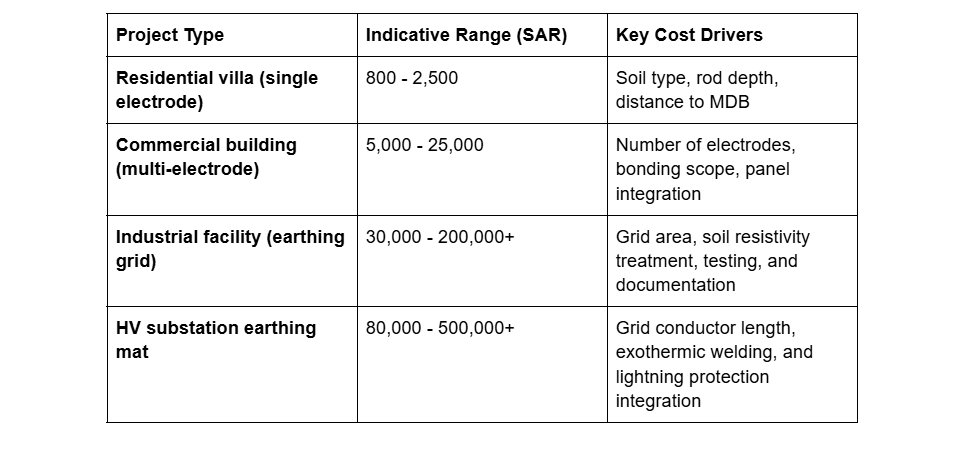
Earthing installation costs in KSA vary significantly based on site conditions, system type, and project scale. Below are realistic indicative ranges not fixed prices to support early-stage budgeting:
- Residential Villa (Single Electrode): Estimated cost ranges from SAR 800 – 2,500, depending on factors such as soil type, earth rod depth, and the distance to the Main Distribution Board (MDB).
- Commercial Building (Multi-Electrode System): Typical pricing ranges between SAR 5,000 – 25,000, influenced by the number of electrodes, bonding requirements, and panel integration scope.
- Industrial Facility (Earthing Grid): Costs generally start from SAR 30,000 up to 200,000+, based on the earthing grid size, soil resistivity treatment, testing procedures, and required documentation.
- HV Substation Earthing Mat: Large-scale substation grounding systems typically range from SAR 80,000 – 500,000+, depending on conductor length, exothermic welding requirements, and lightning protection system integration.
Factors that move costs up or down:
- Soil resistivity: High-resistivity sandy or rocky soils require deeper rods, wider electrode arrays, or chemical earthing compound, all adding cost. A resistivity survey before design saves money by avoiding over-specified systems.
- Rod depth and configuration: Driving rods to 46 m in Saudi conditions requires mechanical equipment. Multiple-rod arrays in parallel reduce resistance but increase labour and material.
- Material specification: Copper-bonded steel rods are cost-effective. Solid copper or titanium-coated rods in aggressive soil add 3060% to electrode material costs.
- Labour and testing: Earth resistance testing, as-built documentation, and SEC inspection coordination are billable items typically 1525% of the total installation cost on smaller projects.
- System integration scope: Connecting the earthing system into a full electrical panel and coordinating circuit breaker settings adds engineering time.
For accurate project pricing, contact El Buroj's technical team with your project BOQ or site survey results.
Call: 920031298 | WhatsApp Us Now
Shop Earthing Materials at El Buroj
El Buroj stocks a complete, IEC-certified range of earthing installation materials for every project scale in Saudi Arabia. Products are sourced from internationally certified manufacturers and are compliant with SEC, SBC, and IEC specifications.
You can browse for all project needs, including full earthing systems and essential accessories such as clamps, busbars, exothermic welding kits, and couplings. The range also includes earthing cables (bare copper and insulated), yellow/green PE cables compliant with IEC standards, and copper-bonded earth rods available in various lengths. In addition, electrical wires, circuit breakers, and electrical panels are provided to support
Why Choose El Buroj for Earthing Systems?
El Buroj is a full MEP electrical supplier serving contractors, engineers, and procurement teams across the Kingdom. For earthing installation, El Buroj provides complete grounding solutions, including system design, material supply, installation, testing, and commissioning, not just earthing materials.
- Full stock availability: IEC-certified electrodes, cables, accessories, and panels ready for immediate dispatch across KSA.
- Bulk supply capability: BOQ fulfilment for single villas through to full industrial earthing grids. Volume pricing available.
- Standards compliance: All products meet IEC certification for SEC-regulated projects. Compliance documentation provided.
- Technical support: Conductor sizing, electrode selection for Saudi soil conditions, and IEC 60364 compliance guidance from specification to delivery.
- Nationwide delivery: Riyadh, Jeddah, Dammam, Al Khobar, Mecca, Medina, and project sites across the Kingdom.
Get your earthing project pricing now.
WhatsApp our technical team: +966534964817 or Call us directly: 920031298
FAQs About Earthing Installation
What is earthing installation?
The process of connecting an electrical installation's non-current-carrying metal parts to earth via buried electrodes and conductors, enabling protective devices to operate and eliminating touch voltage on equipment surfaces.
How deep should earth rods be in Saudi Arabia?
Standard rods are driven 1.2-2.4 m. In high-resistivity Saudi soils, rods are extended to 3-6 m using threaded couplings, or multiple rods are connected in parallel to achieve ≤5 Ω per IEC 60364.
What earth resistance is required in KSA?
≤1 Ω for HV substations, ≤5 Ω for general LV installations, ≤10 Ω for small residential boards. Sensitive instrumentation or data centre facilities may specify ≤0.5 Ω.
What cable is used for earthing installation?
Yellow/green PVC-insulated copper cables per IEC 60446 for above-ground PE conductors. Bare copper for electrode tails and bonding rings. Armoured XLPE for buried runs.
What are chemical earthing compounds used for?
Bentonite-based or conductive cement backfill reduces contact resistance between the electrode and surrounding soil, which is essential in Saudi Arabia's high-resistivity sandy ground. Typically reduces electrode resistance by 40-70% versus natural soil backfill.
How is an earthing system tested?
Using the fall-of-potential method with a calibrated earth resistance tester and two auxiliary electrodes. Clamp-on meters are used for testing in live installations. Results must be documented for SEC inspection.